
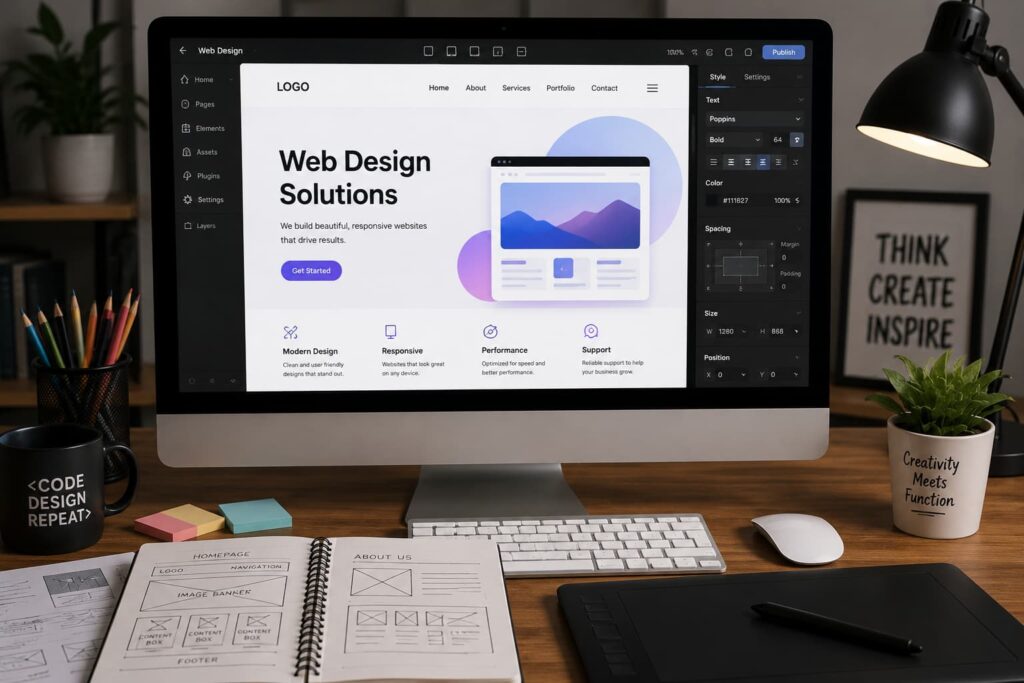

In today’s fast-paced digital world, your company needs more than just a basic website. A professional Web Designing strategy is key to your brand’s identity. It changes how people see your services from the first click.

Having a strong online presence is now a must for businesses. It’s not just a nice-to-have anymore. High-quality visuals and easy navigation build trust with your audience right away.
Good Web Designing keeps visitors interested and turns them into loyal customers. By focusing on user experience, you make your digital presence stand out. This forward-thinking approach helps you stay ahead and secure your success.
Key Takeaways
- Professional site aesthetics build instant credibility with new visitors.
- Strategic layouts directly influence your conversion rates and sales.
- A modern digital footprint is essential for sustainable expansion.
- User-focused navigation keeps potential customers on your site longer.
- Investing in quality digital assets provides a competitive edge today.
The Strategic Importance of Professional Web Designing
In today’s fast-paced U.S. market, your website is often the first thing people see. A top-notch online presence is now essential, not just nice to have. It shapes how people see your brand. Professional Web Designing keeps your digital shop competitive and easy to use.
Defining Modern Web Designing Standards
Modern web standards focus on the user’s experience. Your site needs to be quick, safe, and work well on all devices. This makes search engines like your content more and gives visitors a smooth experience.
Accessibility is also key in modern design. Making your site easy for everyone to use helps you reach more people. It shows you care about everyone. Following these standards is crucial for staying ahead in Web Designing.
Why First Impressions of Web Designing Matter in the U.S. Market
People in the U.S. market expect fast and beautiful websites. Studies show visitors judge a brand in seconds. If your site looks old or slow, they might leave for a competitor.
A well-designed online presence builds trust right away. A clean and easy-to-use site shows you’re reliable and professional. Here’s how professional design differs from amateur:
| Feature | Professional Design | Amateur Design |
|---|---|---|
| Load Speed | Optimized for speed | Slow and bloated |
| Mobile View | Fully responsive | Broken or distorted |
| User Trust | High credibility | Low perceived value |
| Navigation | Intuitive flow | Confusing layout |
Step One: Defining Your Brand Identity and Target Audience In Web Designing
Creating a strong brand identity is key for a top website in the U.S. market. You need to know what your business is about and who it helps. This clarity makes sure your design shows your values and talks to your ideal customers.

Identifying Your Unique Value Proposition In Web Designing
Your unique value proposition (UVP) is what makes you different from others. In a busy online world, you must tell customers why they should pick you. Authenticity is important because people can spot fake messages fast.
To find your UVP, think about the problems you solve and the benefits you offer. When your website shows these clearly, you gain trust with visitors. This focus is crucial for standing out in the U.S. market.

Mapping User Personas for Better Engagement
Creating detailed user personas helps tailor your website to your audience’s needs. By knowing who your visitors are, what they struggle with, and what they want, you can make content that really engages them. This goes beyond just looking at numbers to understand why people click.
Designing with personas in mind makes your website easier to use and more likely to convert. When users feel understood, they stick with you longer. The table below shows how different brand elements affect user interaction.
| Brand Element | Primary Goal | Impact on User Engagement |
|---|---|---|
| Visual Style | Establish Trust | High (Immediate Recognition) |
| Tone of Voice | Build Connection | Medium (Emotional Resonance) |
| Value Proposition | Drive Action | High (Conversion Motivation) |
| User Personas | Personalize Content | High (Relevant Experience) |
By using these insights in your design, your website becomes a powerful tool for growth. A consistent brand identity and focus on user engagement will set your business apart in a crowded market.
Step Two: Prioritizing Responsive and Mobile-First Layouts in Web Designing
Most people will find your brand on a mobile device first. A mobile-first design makes sure your site works well on small screens from the start.
Starting with mobile users means your site will be cleaner and more focused. You’ll remove extra stuff and focus on what really matters to your audience.
The Impact of Mobile Traffic on Conversion Rates
How well your site works on a smartphone affects your conversion rates. If it’s hard to use on mobile, people will leave fast, hurting your sales.
Seamless mobile experiences keep people interested longer. They have more time to look at your products or services. Companies that make their sites mobile-friendly often see more sales and leads than those with old sites.
Ensuring Cross-Device Compatibility in Web Designing
Your site needs to work well on all devices, from phones to desktops. Cross-device compatibility stops people from leaving because of bad layouts or hard-to-read text.
Being consistent is key to building trust in your brand. Users expect the same great experience on any device. By testing your site on different screens, you keep your conversion rates high, no matter how people visit you.
Step Three: Optimizing Website Speed and Performance
A fast-loading website is now a must for digital success. Visitors expect quick responses when they land on your site. Slow loading times can cost you customers before they see your content.
Boosting website speed cuts down on bounce rates and improves search engine rankings. Focus on technical efficiency to keep your audience engaged and moving through your sales funnel smoothly.

Technical Factors Affecting Load Times
Several technical factors affect how fast your site loads. Large, unoptimized images are often the main cause of slow sites. Compressing media and using formats like WebP can greatly reduce data transfer.
Server response time is also key in the initial site interaction. Minifying CSS and JavaScript files removes unnecessary code that slows down loading. Browser caching also helps by storing site assets for faster loading on return visits.
Tools for Measuring and Improving Core Web Vitals in Web Designing
Google uses Core Web Vitals to judge a site’s technical health and user experience. These metrics cover loading performance, interactivity, and visual stability. Keeping an eye on these scores is crucial for staying competitive in search rankings.
Professional tools can help identify and fix performance issues:
- Google PageSpeed Insights: Offers detailed reports on mobile and desktop performance.
- Lighthouse: An automated tool for auditing web page quality and performance.
- Search Console: Provides a detailed view of your site’s performance based on real user data.
Regularly checking these metrics allows for informed design adjustments. Focusing on Core Web Vitals ensures your website speed is optimized for both users and search engines.
Step Four: Implementing Intuitive Navigation and User Experience in Web Designing
Website navigation should be as easy as walking through a store. Visitors expect to find what they need quickly. A smooth user experience keeps them focused on your message, not lost in a confusing layout.
A logical flow boosts user engagement. It makes visitors confident in exploring your offerings.
Structuring Information Architecture for Clarity in Web Designing
Your website’s blueprint is its information architecture. It organizes content in a way that makes sense to visitors. Grouping related topics together helps users find what they need easily.
Effective sites use a top-down structure. They start with broad categories and narrow down to details. This approach avoids overwhelming users and keeps the user experience consistent. A well-organized site also helps search engines index your content better.

Reducing Friction in the Customer Journey
Friction happens when users face barriers. This could be slow forms, broken links, or complex checkout processes. Each extra click can lead to lost customers.
To improve user engagement, make every interaction smooth. Simplify forms and make primary call-to-action buttons easy to find. Removing these hurdles leads to a smoother journey and higher conversion rates.
| Navigation Feature | Impact on User | Business Benefit |
|---|---|---|
| Mega Menus | High visibility of options | Increased page depth |
| Breadcrumb Trails | Clear path orientation | Lower bounce rates |
| Sticky Headers | Constant access to links | Improved conversion flow |
| Search Bars | Instant content retrieval | Higher customer satisfaction |
By focusing on these elements, you make your website a growth tool. A clean, intuitive design is key to a successful online presence that keeps visitors coming back.
Step Five: Integrating Search Engine Optimization Best Practices in Web Designing
Adding search engine optimization to your design phase is key for lasting online success. Many business owners see design and visibility as separate tasks. But they’re closely linked. By planning your site structure with search intent in mind, you make sure your content finds the right audience right away.
On-Page SEO Elements for Better Visibility
Good on-page optimization begins with organizing your content well. Use clear, descriptive header tags to help search engines understand your site’s structure. Each page should have unique meta descriptions and title tags that match the content.
Also, don’t forget the importance of image optimization. Always add descriptive alt text to your images. This improves accessibility for all users and gives search engines more context about your media, boosting your search engine optimization efforts.
The Relationship Between Design and Search Rankings
Your website’s layout affects how search engines rank your pages. Modern algorithms favor sites that offer a smooth user experience. Your design choices are key ranking factors. A messy or confusing layout can lead to high bounce rates, telling search engines your site might not be relevant.
Technical performance and structure are the base of a top-ranked website. Prioritizing clean code and easy navigation helps search engine crawlers index your pages better. By aligning your design with search engine optimization principles, you create a site that pleases both your visitors and modern search algorithms.
Step Six: Leveraging Visual Hierarchy and Call-to-Action Placement
Design choices guide your audience to key content. Organizing info logically ensures visitors focus on what’s important. A good visual hierarchy avoids clutter, making the experience smooth and professional.
Guiding User Attention with Strategic Design
Design is about how you use size, color, and position. Large fonts and bold colors draw attention first. This makes information easy to process without feeling overwhelmed.
Don’t forget the power of white space. White space gives content room to breathe. It helps visitors move through your site easily and naturally.
Crafting High-Converting Call-to-Action Buttons
Your call-to-action (CTA) buttons are where visitors end up. To increase conversion rates, make these buttons stand out. Use colors that contrast with your brand but still match it.
Use action-oriented text in your buttons. Instead of “Submit,” say “Get My Free Guide” or “Start Your Trial.” This creates a sense of urgency and encourages clicks.
| Design Element | Purpose | Impact on Conversion Rates |
|---|---|---|
| Button Color | Create Contrast | High |
| Button Text | Drive Action | High |
| Visual Hierarchy | Direct Focus | Medium |
| White Space | Reduce Clutter | Medium |
Test different placements and styles to improve your design. The goal is to make the path to purchase or contact simple. When design meets user needs, it persuades and drives results.
Step Seven: Building Trust Through Professional Aesthetics and Security
In the U.S. market, professional looks and strong security are key for growth. When someone visits your site, they quickly judge your trustworthiness. To build trust, you need a site that looks great and is very secure.
The Role of SSL Certificates and Data Privacy
Security is crucial for online relationships. SSL certificates are now a must-have to protect data. They show a padlock in the browser, meaning your info is safe.
Your privacy policy must be clear and easy to find. It should explain how you handle user data. This shows you care about digital safety, which is important to today’s consumers.
“Trust is the glue of life. It’s the most essential ingredient in effective communication. It’s the foundational principle that holds all relationships.”Stephen Covey
Using Social Proof and Testimonials Effectively
After securing your site, show your value. Trust building gets a big boost when people see others are happy with you. Using social proof can make your reputation stronger.
Here are some ways to boost your credibility:
- Client Testimonials: Use real quotes from happy customers to show results.
- Industry Badges: Show off certifications or awards to prove your skills.
- Case Studies: Share how you solved big problems for others.
By adding these, you make a site that’s not just pretty but also reliable. A secure, well-designed site is a reliable partner for your customers. It builds loyalty and helps your business grow over time.
Step Eight: Analyzing User Behavior to Refine Your Design
Designing a successful site means moving away from guessing. It’s about using data to guide your decisions. Once your site is live, you start optimizing by watching how people use it. A data-driven design approach means every change is based on facts, not just what you think.
Utilizing Heatmaps and Analytics Tools
To really understand your audience, you need to look at their digital trail. Tools like Google Analytics give you lots of info on who visits your site, how long they stay, and where they go. This helps you see which pages work well and which ones don’t.
Heatmaps give a visual look at where users click, scroll, and hover. They show you if your call-to-action buttons are in the right place. If users are missing a key link, a heatmap will show you right away.
Iterative Design Based on Data-Driven Insights
The best websites are always changing. They’re seen as ongoing projects that need updates based on data-driven design. This cycle of making small changes and checking their effect helps improve your site.
If you find a problem in the user journey, fix it and watch how it does. Small changes can make a big difference over time. By always refining your site, you keep up with your visitors’ needs and stay ahead of the competition.
Common Pitfalls to Avoid During the Web Designing Process
Many businesses harm their online presence by ignoring key design principles. Creativity is vital, but your Web Designing must also be grounded in reality. This ensures long-term success.
It’s crucial to avoid certain mistakes and focus on the right features. Spotting these common traps early helps protect your brand and keeps your site running smoothly.
Overloading Pages with Excessive Media
Cluttering your site with too many videos and images is a common error. These elements might look great but can slow down your site. This makes visitors unhappy.
Too much media makes the browser work too hard. This can lead to users leaving your page before it loads. Use optimized assets to keep your site fast and easy to use on all devices.
A simple, clean design helps focus visitors on your main goals. By removing unnecessary clutter, your message becomes clearer to your audience.
Ignoring Accessibility Standards and Compliance
A professional site must be accessible to all. Ignoring Accessibility standards limits your audience and can lead to legal problems.
Using proper alt text, high-contrast colors, and keyboard navigation is key for Web Designing. These steps make your site inclusive and follow current digital laws.
Following these Accessibility standards shows you value all customers. It also helps your site rank better in search engines, as they favor accessible sites.
| Common Mistake | Primary Impact | Recommended Solution |
|---|---|---|
| Heavy Media Files | Slow Page Speed | Compress and Optimize |
| Poor Color Contrast | Accessibility Issues | Follow WCAG Guidelines |
| Complex Navigation | High Bounce Rate | Simplify Architecture |
| Missing Alt Text | SEO & Compliance | Add Descriptive Tags |
Conclusion
Your website is the digital heart of your business. It’s a key tool for growing your business in a busy market. Every design choice affects how people see your brand and use your services.
Think of your site as a living thing that needs care and updates. Regular checks and data analysis keep it fresh for users. This keeps your business growing while others try to catch up with digital trends.
Stick to these design rules to connect with your audience better. A well-made, fast, and safe website is the base for success. Start improving your online strategy today to see the difference in your profits and growth.
Let us know what design changes have helped your site the most. Talking to your audience online builds loyalty. Move forward in making your online presence more effective today.
FAQ
Why is professional web designing considered a necessity for U.S. businesses today?
A website is often the first thing people see of your brand. Professional web design makes your site look modern and trustworthy. Without a good website, you might lose customers to competitors who have better sites.
How does a mobile-first design strategy impact my conversion rates?
Most people use smartphones to browse the internet. Google now favors mobile-friendly sites. A site that works well on phones helps customers find what they need easily. This leads to more sales and fewer people leaving your site.
What are Core Web Vitals, and why are they important for my website’s performance?
Core Web Vitals are Google’s way to measure how well a site works. They look at how fast a site loads and how easy it is to use. Improving these areas helps your site rank better and keeps visitors from leaving because of slow loading times.
Can the design of my website actually improve my Search Engine Optimization (SEO)?
Yes, good web design can help your site rank higher. It includes things like clean code and proper use of tags. A well-organized site makes it easier for search engines to find your content, helping more people find you online.
How can I use visual hierarchy to drive more sales?
Visual hierarchy uses size and color to draw attention to important parts. Place Call-to-Action buttons where they’re easy to see. This makes your site more engaging and can lead to more sales.
What security features are essential for building trust with online customers?
Every site needs an SSL certificate to keep data safe. Showing the “HTTPS” padlock in browsers helps too. Adding social proof and clear privacy policies also builds trust and follows the law.
How do tools like heatmaps help in refining a website’s design?
Heatmaps show where users click and scroll. Tools like Hotjar help you see what works and what doesn’t. This data helps you make your site better for everyone.
What is the risk of ignoring web accessibility standards?
Ignoring accessibility can leave out many potential customers. It also risks legal trouble. Making your site easy for everyone to use improves your site and your brand.